Hey,
It’s Michał in the last update of 2025! The React Native community is not slowing down at the end of the year, so you’ll learn about new frontiers, new UI frameworks, how to build a high quality app, what we’re building in the on-device AI space, creating rich iOS Live Activities with React ,and our current and future CSS contributions to React Native. Enjoy the read! And when you’re done, enjoy the holidays with your loved ones, you’ve all earned it 🎄.
Community highlights
- React Native 0.83 ships with no breaking changes: In the last major release of 2025, the team delivered quite a few exciting features without breaking anything. A huge milestone for React Native’s stability! Key updates include React 19.2 with Activity and useEffectEvent APIs, React Native DevTools as a standalone macOS app (it’s Electron, btw) with a Network panel and Performance tracks, stable Web Performance APIs, and the introduction of Intersection Observer at the Canary release level. Upgrading should be pretty smooth.
- Critical security vulnerability in RSC in React 19: A remote-code-execution bug was disclosed affecting React 19’s React Server Functions and React Server Components (RSC). If you use React 19 or any framework built on it, please upgrade React to 19.0.1, 19.1.2 or 19.2.1 ASAP if your app uses RSC.
- Godot assets in React Native: This new package from Born allows you to embed 2D and 3D scenes and physics interactions directly with React Native and its gesture system. It supports iOS and Android out of the box. Speaking of game engines, together with Szymon Rybczak we’ve met Danny Povolotski who’s building React Native renderer for Unreal Engine. Look for more updates from us on this front soon.
- How we built the v0 app: Vercel recently released a mobile app for v0.app and it quickly became one of our favorite apps. It was one of the finalists for the Expo App Awards and set a high bar for delightful user experience for any mobile app, not only React Native apps. In this article Fernando Rojo, who’s leading the team, shares the process and principles that they follow to achieve the highest quality possible.
- react-native-tailwind: The race for getting Tailwind to React Native is not done yet. After Uniwind, and later Expo announcing its own plans for tailwind support, we have a new library that, interestingly, has no runtime dependencies, as it’s mostly a Babel plugin that compiles ahead of time.
- Mini Apps Partner Program from Apple: This program further acknowledges native iOS host apps that embed “mini-apps” built with web technologies (HTML5/JavaScript) and, if you adopt Apple’s required APIs (e.g. Advanced Commerce API, Declared Age Range API), receive a favorable 85% revenue share on in-app purchases inside those mini-apps, instead of getting 70% after App Store commission.
- State of React and State of React Native surveys: It’s this time of the year, where we’re in a little bit more of reflection mode, thinking about the past, and planning for the future of 2026. As a part of that process we highly encourage you to take part in the biggest React and React Native surveys, that capture tools, trends, and usage patterns in these communities.
- Valdi: new cross-platform UI framework from Snapchat: 2025 is a year of new mobile frameworks: first was Lynx from ByteDance and now Snapchat released its own Valdi. It’s a TypeScript based frameworks that powers Snapchat’s Android, iOS and macOS apps from their beginning. Similarly to Lynx it’s not tied to React, but it uses a similar declarative model. And it uses Yoga layout engine which we know from React Native. Check out our live where we go through Valdi in-depth.
Callstack Incubator highlights
ArrayBuffer support for TurboModules
After consulting our article on sharing memory between JS and native land with Tzvetan Mikov from Hermes team, lead expert on JSI, we decided to take it back and rewrite to avoid confusion. In this article Kamil is explaining how memory handling differs between C++ and garbage-collected JS, how it affects JSI, sync vs async workflows and many more. If you like to dig deep into how things work, we highly recommend reading it.
React Native AI
We recently learnt that @react-native-ai/apple package for accessing Apple’s Foundation Models using AI SDK interface that we released recently, is already used in production by Inferra and Esper apps on App Store. So cool! Check these apps and let us know how offline LLMs are helpful.
I’ve also gave a talk about React Native AI project during DevAI by Data Science Summit to spread the word about on-device processing outside of our typical React Native niche.
Voltra
Szymon is busy perfecting Voltra that we announced last month, and plan to release in December. He’s also busy dropping some jaw-dropping demos of the capabilities of turning JSX to SwiftUI that works with fast refresh and everything.
From a lower level perspective, we hit a few blockers using older implementation that was based on react-reconciler and so we decided to roll out our own custom React renderer from scratch, which wasn’t that much harder than using the package.
Szymon also heavily improved the amount of data you can pass to the live activity (limited to 4 KiB) thanks to Brotli compression, so you can build richer experiences with more images and other visuals.
Experimenting with DOM APIs
Szymon is also experimenting with recent DOM API additions to React Native 0.82, which makes it possible to e.g. run this web library for masonry layout in a native mobile app without modifications. It’s just a fun experiment, no library plans at this point, but we thought it’s cool to share. Maybe this will inspire someone to port or reuse more web libraries in React Native.
React Native Bottom Tabs
Oskar is briefly back in Incubator and he started with a round of fixes around Android SVG, freezing when popping to root, macOS compilation, ESM/CJS for expo configs, and also adds experimental accessory views (that are also coming to Expo Router in SDK 55).
React Navigation
Satya is busy shipping many bug fixes and type improvements to React Navigation 8, that is coming soon. One of the goals for the release is to have full type-inference without any explicit type annotations.
And closer to the ground, a functionality that recently landed in v7 that we’d like to mention is handling authenticated deep links that “remember” which screen they pointed to.
Core React Native contributions
A few of our team members, namely Kamil and Artur, are busy contributing to React Native directly. Here’s what they build currently:
CSS clip-path support
This PR adds support for clip-path CSS attribute for JS. It follows CSS spec described here. It does not provide support for SVG source (<clip-source> values), what can be added in the additional PR if needed. Supported syntax is [<basic-shape>] || <geometry-box>] with almost full support of every basic shape (<basic-shape> = circle | ellipse | rect | polygon | inset | xywh) and references boxes (<geometry-box> = margin-box | border-box | padding-box | content-box | fill-box | stoke-box | view-box).
.png)
Followup PRs for iOS and Android.
CSSmasksupport
Kamil also works on support mask CSS attribute which will allow us to drop 3rd party components handling view masking behavior today. There’s no open PRs yet, but we expect them to land in the upcoming days.
CSS calc support
Another CSS property on our list, that has a good potential for RSC apps and unblocking media queries is calc. Artur works closely with the team at Meta to figure out the path forward, but it’s still early days.
SceneDelegate migration RFC for iOS
Artur sent this draft PR a while back as one of the ground work for better window resizing behavior for iPadOS 26. It turned out to address too many concerns, and also in a breaking way. As a followup we’re working on the next iteration of this effort and a public RFC to get some community feedback on the topic.
Guide
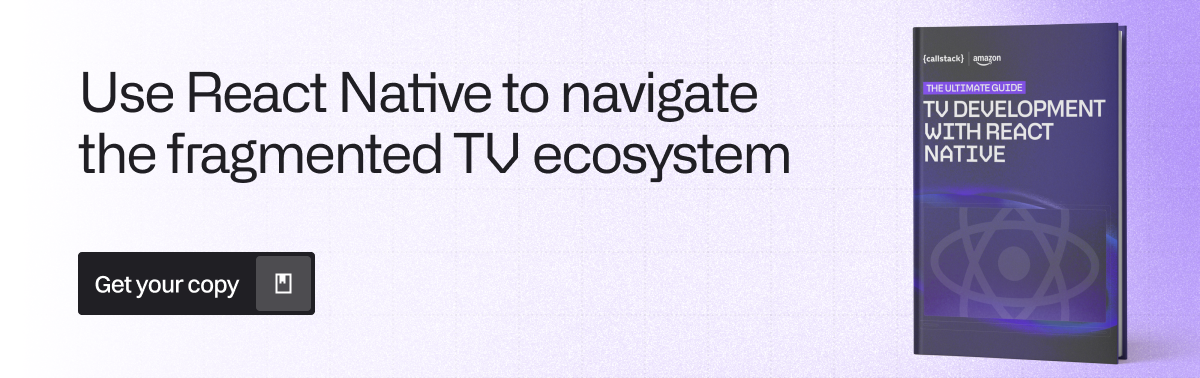
To step into 2026 with impact, we once again teamed up with Amazon and released a new guide: The Ultimate Guide to React Native TV Development. This major update of our last year’s ebook is designed for teams building apps for tvOS, Android TV, Tizen, and webOS, and for anyone looking to understand the unique engineering landscape behind living-room experiences.
It covers:
- How modern TV platforms differ in hardware, OS constraints, and input models
- Core principles of designing for the 10-foot experience and remote-driven navigation
- Building performant TV apps with React Native and react-native-tvos
- Focus management, video playback, accessibility, and testing strategies
It gives you a clear, practical path to designing and shipping reliable React Native TV apps across today’s fragmented device ecosystem.
Blog
If you prefer to jump straight to the blog post versions of our releases, there you go:
- Deep Links With Authentication in React Navigation by Satyajit Sahoo:
This article walks through how to make deep links work when the screen is behind authentication, so the user automatically navigates to the correct deep link after logging in. It discusses manual approaches to implement this, the downsides of these approaches, and shows how React Navigation 7 introduces a built-in option with UNSTABLE_routeNamaesChangeBehavior that makes it easier to handle. - Integrating Swift Package Manager With React Native Libraries by Mike Grabowski: React Native has relied on CocoaPods for iOS dependency management, but Swift Package Manager has become the preferred option for modern Swift development due to its performance and tight Xcode integration. Since React Native 0.75, the spm_dependency helper lets libraries declare SPM packages directly in their podspec files, enabling support for third-party Swift packages distributed only through SPM. This article explains how the integration works, how to adopt it for both remote and local packages, and what to expect until official support ships.
- Memory Ownership Models: When JavaScript Meets Native Code by Kamil Paradowski: React Native makes it easy to pass data between JavaScript and native code, but things get complicated once you leave the synchronous path. This article explains what really happens when ArrayBuffer memory crosses the JS and native boundary, why raw pointers can become invalid during async work, how garbage collection affects native code, and what safe patterns you can use today.
- How to Release a React Native App on the Meta Horizon Store by Jan Jaworski: This article walks through the full release flow for React Native apps on Meta Quest, from preparing a production build to submitting it through the Horizon Store. Developers will learn the technical steps, required tools, and best practices for store‑ready assets. It also highlights common review pitfalls, guidance for creating high‑quality screenshots, monetization options, and tips for shaping a smooth submission workflow. By the end, readers will understand how to take a Quest app from development to a polished, store‑ready release.
Podcasts and Interviews
- React Universe On Air: Bringing React Native to VR on Meta Quest by Jan Jaworski, Ram N & Łukasz Chludziński: Learn how Meta Quest uses React Native for 2D panels in 3D spaces, why AOSP matters, and how developers can bring existing RN apps to VR with minimal friction.
- From Static Hermes to Hermes V1: The Road to Default by Nicola Corti & Łukasz Chludziński: Nicola Corti (Meta) explains the evolution of Static Hermes into Hermes V1, the performance boosts it ships, and the (experimental) path to making it the new default engine.
- From React Native Web to React Strict DOM by Nicolas Gallagher & Łukasz Chludziński: Nicolas Gallagher (Meta) explains how React Strict DOM evolved from React Native Web, providing a shared syntax that compiles to native or web with zero overhead.
- Amazon's Vega OS: A New OS With React Native Built-In by Giovanni Laquidara & Łukasz Chludziński: Giovanni Laquidara (Amazon) introduces Vega OS, a new lightweight operating system with React Native built-in, designed for high-performance on low-end media devices.
- It's Not New: How 'The Architecture' Unlocks React Native's Future by Riccardo Cipolleschi & Łukasz Chludziński: Riccardo Cipolleschi (Meta) explains why the New Architecture is now just The Architecture and how it serves as the foundation for concurrent rendering, DOM APIs, and Hermes V1.
- React Foundation: New Governance Model for React and React Native by Seth Webster & Łukasz Chludziński: Seth Webster, Executive Director of the React Foundation, details its new governance model, Meta's role, and how partners like Callstack and Microsoft will ensure stability and scale.
Webinars and live streams
- Scaling React Native at Zalando: How Brownfield Migration Paid Off recording
- React Native on Meta Quest: A Developer’s Guide to Building for VR recording
- Two Threads of Lynx.js Part 2 recording
- Exploring Lynx.js and Its Two-Thread Runtime recording
- Introducing Solito 5 and the Web-Native Mindset recording & summary
- Inside Valdi: What We Learned Exploring Snapchat’s New UI Framework: recording & summary
That’s a wrap for the November edition. Enjoy the holidays, recharge, and we’ll see you in the New Year!
Your next read or watch starts here
Stay up to date with our latest insights on React, React Native, and cross-platform development from the people who build the technology and scale with it daily.