Two Threads of Lynx.js Part 2
Two Threads of Lynx.js Part 2
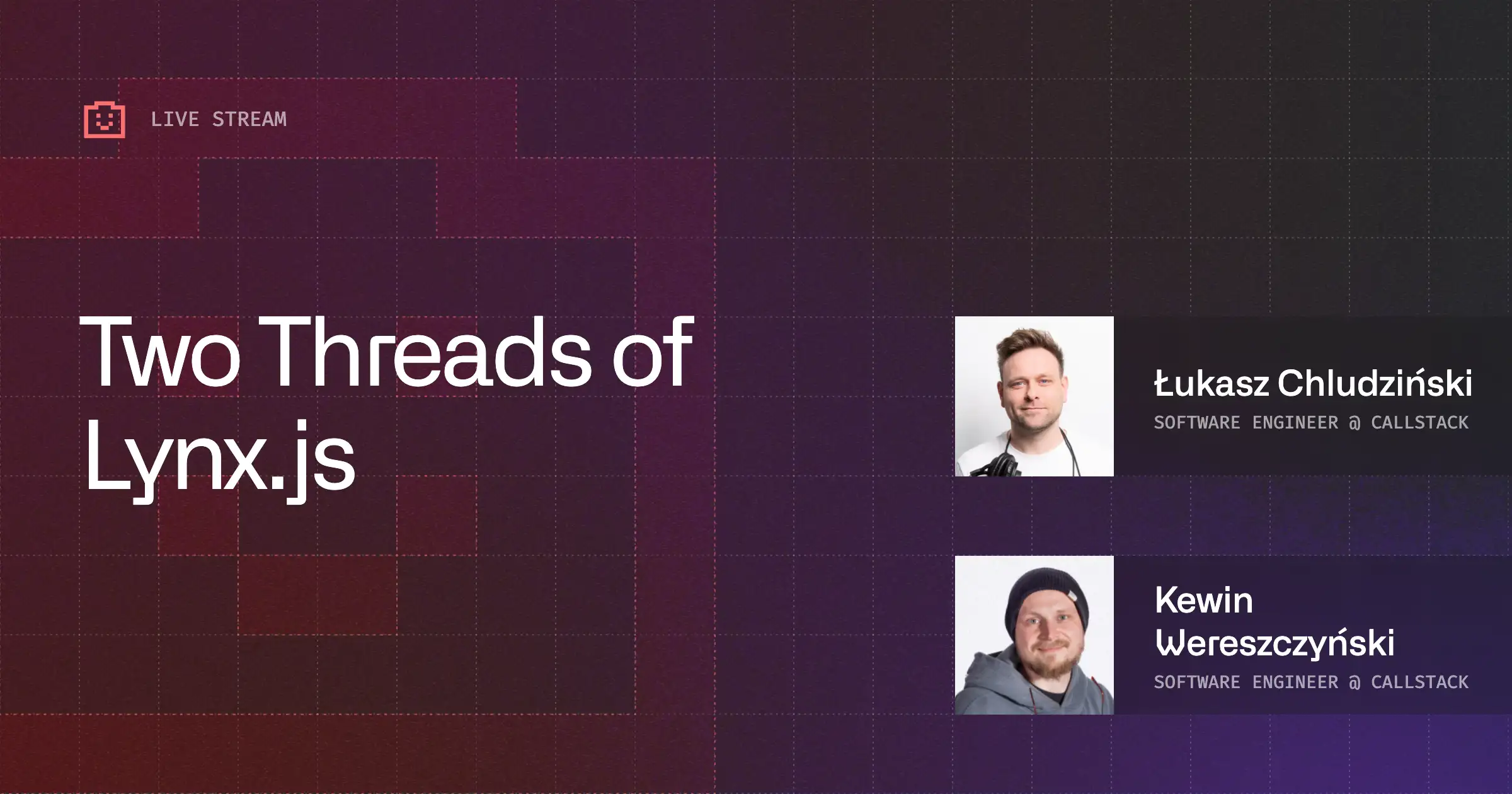
Learn how Lynx.js uses a dual-threaded model, how its APIs work, and what it means for performance in this live session with Lukasz Chludzinski and Kewin Wereszczynski.
Two Threads of Lynx.js Part 2



Continuing the Lynx.js exploration
This article summarizes the second installment in an ongoing exploration of Lynx.js and its two-thread runtime model. Building on the first session, the focus shifts to further practical work with Lynx, using the official Product Detail tutorial as a reference point. Rather than introducing new concepts from scratch, this part extends earlier findings and observations.
Revisiting the two-thread execution model
Lynx.js separates application logic from UI work by default, running user code on a background thread while reserving the main thread for rendering and interaction-critical tasks. This distinction is reflected directly in the API, where thread-specific bindings are exposed as part of component props. As a result, execution context becomes explicit and encourages deliberate placement of logic based on performance and responsiveness requirements.
Working through the product detail tutorial
The session follows the Product Detail tutorial step by step, assembling a screen with a swipeable image gallery and supporting UI elements. Along the way, the example highlights how JSX structure, styling, and assets are organized in a Lynx project. While many patterns resemble familiar web or React workflows, thread-aware directives introduce an additional layer to how components and interactions are designed.
Interaction flow and performance considerations
The swiper example provides a practical view into how interactions are handled across threads. Touch and scroll-related logic that requires immediate UI feedback is moved onto the main thread, while other computation remains on the background thread. Observing these decisions in a working example helps clarify how Lynx’s two-thread model is intended to reduce latency without overloading the main thread.
What comes next
This second part continues to establish a foundation for understanding Lynx.js execution and interaction patterns. With the basics of thread separation and main-thread bindings covered, future explorations can focus on more advanced communication between threads and broader application scenarios.
Two Threads of Lynx.js Part 2
Learn how Lynx.js uses a dual-threaded model, how its APIs work, and what it means for performance in this live session with Lukasz Chludzinski and Kewin Wereszczynski.

Learn more about Cross-Platform
Here's everything we published recently on this topic.








React Native Performance Optimization
Improve React Native apps speed and efficiency through targeted performance enhancements.
C++ Library Integration for React Native
Wrap existing C-compatible libraries for React Native with type-safe JavaScript APIs.
Shared Native Core for Cross-Platform Apps
Implement business logic once in C++ or Rust and run it across mobile, web, desktop, and TV.
Custom High-Performance Renderers
Build custom-rendered screens with WebGPU, Skia, or Filament for 60fps, 3D, and pixel-perfect UX.