Introducing Solito 5 and the Web-Native Mindset
Introducing Solito 5 and the Web-Native Mindset
Join us on November 20 for a deep dive into Solito 5 with its creator, Fernando Rojo, and the Callstack team.
Introducing Solito 5 and the Web-Native Mindset
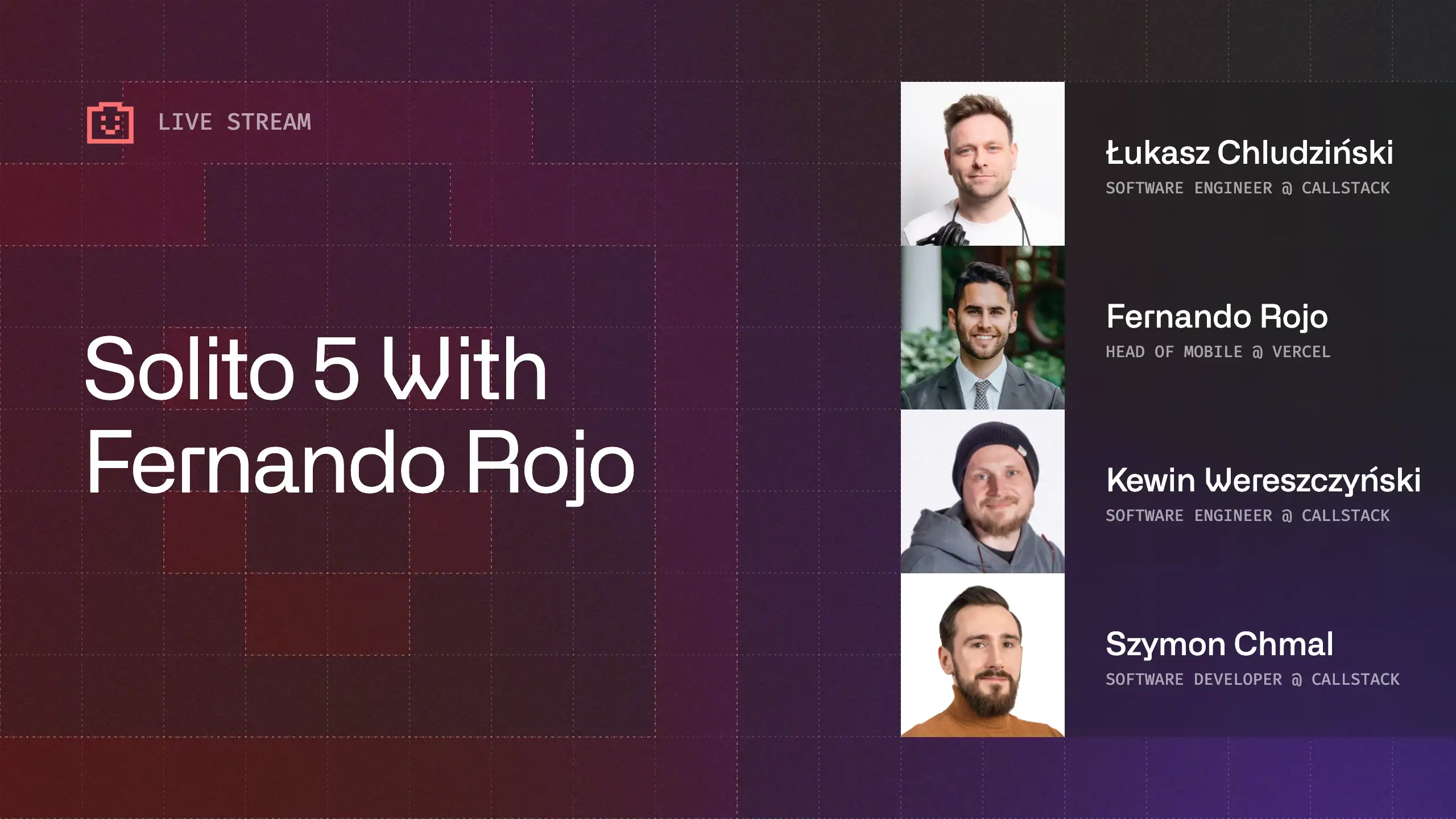





This week’s session brought Fernando Rojo, the creator of Solito and Head of Mobile at Vercel, to walk us through Solito 5 and the patterns behind building truly shared web and mobile experiences.
Introducing Solito 5
The conversation kicked off with the motivation behind Solito: giving teams a way to write React Native and Next.js apps that share screens, logic, and structure without compromising the strengths of either platform. Solito’s core ideas center on flexibility rather than forcing a single paradigm across platforms. Navigation remains native to each environment-React Navigation or Expo Router on mobile, and Next.js routing on the web, while the screens and business logic live in shared packages.
How Solito structures cross-platform projects
Fernando walked through the starter setup: a monorepo with apps/ for platform shells and packages/app for shared screens and logic. The key concept is simple but powerful: the “app shells” on each platform decide how navigation and routing work, while the screens themselves stay platform-agnostic. This avoids the pitfalls of trying to replicate mobile navigation on web, or forcing web layout patterns into React Native.
Instead, Solito provides a small set of primitives-like Link and typed routes, that adapt to both environments. When needed, platform-specific files (.native.tsx, .web.tsx) allow for fine-grained behavior without fragmenting the codebase.
Real-world constraints: Auth, styling, and navigation
Then, we explored real-world scenarios where the two platforms diverge. Take authentication as an example: mobile might use Apple or Google sign-in, and web might use cookies or server-managed sessions. Fernando explained how to approach these differences through shared interfaces and platform-specific implementations.
We also covered platform-aware navigation, gradual adoption paths, and how teams can migrate an existing Expo or React Native project into a Solito monorepo without a full rewrite. Solito pairs especially well with Expo Router since both ultimately target React Navigation under the hood.
The state of styling: React Native Web, Strict DOM, Uniwind, and more
A major update in Solito 5 is the removal of React Native Web from the core web rendering path. Instead, Solito now renders pure HTML + Next.js components, which opens the door to modern styling solutions like Tailwind, ShadCN, and design systems without React Native Web’s constraints. Fernando discussed upcoming tools like Uniwind, high-performance Tailwind for native, and React Strict DOM, which flips the classic approach by bringing web styling primitives to native instead of the other way around. Both offer a glimpse of how shared UI may evolve.
Building cross-platform apps without compromises
The session highlighted a key philosophy behind Solito: shared code should not come at the cost of platform quality. Solito exists not to merge web and native into a single abstraction, but to allow teams to build first-class experiences on each side while reusing as much logic and UI as possible.
Fernando emphasized that Solito shines in mature, multi-target apps where teams care about performance, fine-tuned navigation, and long-term maintainability. For newer developers, Solito’s flexibility may feel overwhelming at first, but its patterns closely follow how real production apps evolve over time.
What’s next for Solito and the ecosystem
Fernando teased ongoing work in the ecosystem, from Uniwind to Vercel’s mobile efforts-and encouraged developers to explore Vercel’s new v0 app, built heavily with React Native and native code. He also hinted at a deep-dive blog post about the app’s architecture, spanning AI, native modules, and cross-platform UI.
Introducing Solito 5 and the Web-Native Mindset
Join us on November 20 for a deep dive into Solito 5 with its creator, Fernando Rojo, and the Callstack team.

Learn more about Cross-Platform
Here's everything we published recently on this topic.












React Native Performance Optimization
Improve React Native apps speed and efficiency through targeted performance enhancements.
C++ Library Integration for React Native
Wrap existing C-compatible libraries for React Native with type-safe JavaScript APIs.
Shared Native Core for Cross-Platform Apps
Implement business logic once in C++ or Rust and run it across mobile, web, desktop, and TV.
Custom High-Performance Renderers
Build custom-rendered screens with WebGPU, Skia, or Filament for 60fps, 3D, and pixel-perfect UX.