Hey,
It’s Michal shipping May’s edition of the newsletter from App.js conference—it’s been great so far. As always, great job to Paulina and SWM!
This month was full of supply-chain attacks on npm, big releases from Expo, React Vision, and William Candillon, and as always, an update from our Incubator team open source projects. Let’s go!
Community highlights
- TanStack and Next.js security releases due to npm supply-chain attacks: The two biggest frontend frameworks got hit by different security vulnerabilities. A good reminder that trusted publishing (OIDC) is not a silver bullet. Upgrade your dependencies, vet and pin GitHub Actions to a specific version, and configure trust policy in your package managers.
- Expo SDK 56: This is a packed release: Expo UI stabilizing and replacing many community libraries, React Native 0.85, React 19.2, Hermes V1, Expo Router forking React Navigation, faster native modules, and better build defaults. Upgrade with a single command or let agents do it using Expo upgrade skills.
- React Native SWC: A new package to replace Babel transforms with Rust-based SWC for speed, brought to you by Joel Arvidsson—known from hits like react-native-performance, react-native-vector-icons or react-native-native-animatable. In typical scenarios it should get your JS bundling 3x faster (transforms are actually ~8x faster but that’s not all the work that Metro is doing).
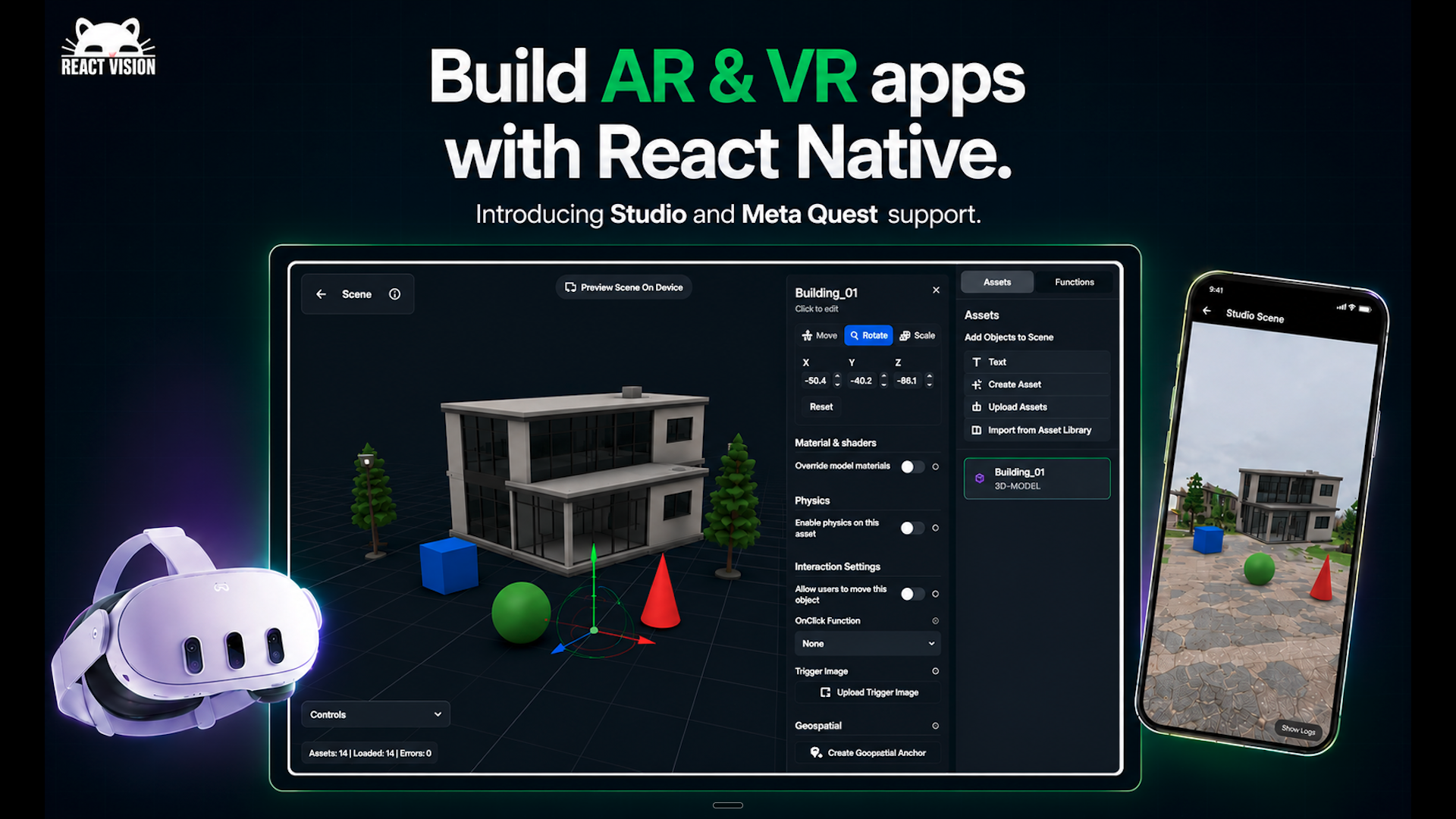
- ReactVision shipped Studio for AR/VR in React Native: A browser-based visual editor where you drag in 3D objects or generate them from text with AI, then ship to iOS, Android, and Meta Quest with a single React Native component. No Unity, no game engine. It works directly with ARKit, ARCore, and HorizonOS via ViroReact (MIT licensed, 100K+ npm installs). Free to try. [sponsored].
- Making JSI Faster with Efficient Data Structures: A great native-module engineering read. from our friends at Margelo. The useful part is not “JSI can be fast”, but how easily it gets slow when the data shape crossing the boundary is wrong. C++ is hard folks.
- Redraw: William Candillon and TypeGPU teams cooked! Redraw is a 2D graphics library built on top of WebGPU. It supports variable strokes, colors along paths, physically based renderings, and vector feathering which allows fast blurs that don't require any rasterization step. This enables use-cases such as analytical motion blur or fast backdrop filters.
Callstack Incubator highlights
Apex
Our AI team, led by Piotr Miłkowski, just released something special, and a big milestone for Callstack Incubator: Apex, our own Large Language Model, specialized for coding React Native apps. It’s also pretty cost-efficient thanks to all the GPU infra optimization Piotr was able to pull off. Apex is based on Gemma 4, adapted specifically for React Native coding work. We couldn’t be more excited!
We started with proof-of-concept experiments on other bases, including Devstral and Qwen. After early testing, we moved to Gemma 4 because the base model was already stronger for React Native work before specialization, and it proved to be great for tuning.
From there, we trained Apex using Supervised Fine-Tuning (SFT) and Group Relative Policy Optimization (GRPO).
Apex performs similar to SOTA models in popular coding benchmarks, and currently sits at 3rd place in our own React Native Evals, behind Composer and before GPT-5. We’ll be releasing more information and benchmarks soon.
We want to create the best model for building and understanding React Native apps. Read more about it and help us test it by becoming an early adopter—sign up here.
Agent Device
We’ve reached over 100k weekly downloads. What! I guess you like it when your agents do the work for you. I like it too.
I’ve been nerd sniped by Maestro running the same user flows faster, so I’ve taken the time and effort to improve performance of agent-device all across the board. The replay test runs are now over 3x faster, and common interactions such as snapshot, click, fill are up to 7x faster. I’m especially happy with interactive snapshots and clicks taking usually under 400ms on an M4 machine, which means when combined with batching, agents can control the simulators almost as quickly as humans (not the hyperactive ones that stress test list performance, but we’ll get there!), speeding up the feedback loop considerably.
Oh, and we’ve shipped support for Maestro yaml test format which you can run with agent-device test --maestro – give it a try and report bugs and missing features! We're also dropping or internalizing some dependencies to avoid supply-chain attack surface.
One fun use case for agent-device we’ve found in the wild: NativeWind uses it to automate issue reproductions, neat!
React Navigation
Satya is shilling React Navigation 8 even more with a new retain API which will give you unprecedented ease of supporting picture-in-picture on iOS. Just be careful with memory usage! In v8 you can also expect reworked SSR support to work with streaming rendering.
Rozenite
Szymon, together with a team of external and internal contributors, keeps making Rozenite what is hopefully the best plugin ecosystem for React Native development. Recently they added support for Nitro Fetch in the Network Activity plugin, so you can use multiple fetching libraries and get a unified view of the outgoing and incoming network traffic.
React Native Evals
We’re constantly updating React Native Evals with more models as they release. We recently added Claude Opus 4.7, OpenAI GPT-5.5, Callstack Apex. And as you read this, we’ll hopefully have results for Opus 4.8, Composer 2.5, Gemini 3.5 Flash, Kimi 2.6, Mimo v2 5 Pro, and Mistral 3.
We’re also adding more categories, such as 2D graphics with Skia which we collaborate on with William Candillon, and a suite of common and uncommon bugs Callstack engineers found in the React Native apps they developed. Stay tuned!
Inspector
Hur and Szymon were fed up with not being able to easily profile performance in release variants of their React Native apps so they decided to build it, and now you can use it too. Meet: @callstack/inspector. Not only can you inspect the React component rendering tree through DevTools, but you can also put React.Profiler directly in your app to get better runtime instrumentation where you need it.
The setup is simple, involves changes to Metro config, and works with Expo and any React Native app. Check out @callstack/inspector and give us feedback!
React Native Brownfield
Artur, together with Hur and other contributors, are quietly making Brownfield a bulletproof library, fixing bugs, and long-standing issues such as support for iOS prebuilds or Expo SDK 55 with a config plugin. Did I mention we also got Expo Updates to work so now you can OTA your brownfield apps? Now you know.
And to add a small spice to this update, we’ve shared an agent that Hur is working on for automated migrations from any tech stack to React Native. It works with brownfield and greenfield setups by understanding the app run in a simulator and then rebuilding it in React Native and verifying results with Agent Device. With this setup we’re able to migrate the same screen 3x faster at comparable quality. E-mail us if you’d like to learn more or migrate your app to React Native.
React Native contributions
We’re past the first working group meetings as part of React Foundation and delegated Satya and Kamil to represent Callstack in Fabric and Stable API efforts. With the help of the core team, Kamil was able to unblock the ArrayBuffer support in TurboModules, landing the C++ part and now following up with corresponding iOS and Android work. CSS calc is still pending review.
Blog
If you prefer to jump straight to the blog post versions of our releases, there you go:
- Introducing Apex: A Fast, Specialized Model for React Native by Mike Grabowski: Today, we are introducing Apex, our first domain-specific coding model designed for React Native. Built on Gemma 4, Apex achieves frontier-level performance at a fraction of the cost of generalized models. It is optimized for the fast, agentic workflows our teams run daily, delivering up-to-date results with fewer tool calls.
- Profile React Components in React Native Release Builds by Hur Ali: @callstack/inspector brings React component profiling to React Native release builds. This article walks through the setup in an Expo app and shows how to inspect performance closer to how users experience it, without development-only debug code affecting JavaScript execution.
- Agencies or Swarms? What Small Model Cooperation Means for AI Engineering by Lech Kalinowski: Agentic systems may not depend only on larger models. This article examines how swarms of smaller models behave under load and what that means for distributed inference, concurrency, and infrastructure design.
- Using TurboModule Substitution to Build Safer React Native Plugin Systems by Aliaksandr Babrykovich: Plugin systems and micro-app architectures need more than a simple allowlist for native modules. This article shows how react-native-sandbox introduces TurboModule substitution, giving hosts a practical way to expose sandbox-safe native functionality for files, storage, analytics, networking, and more.
- Unlocking Expo Updates in an Isolated Brownfield Architecture with SDK 55 by Hur Ali: Expo Updates used to be a pain point for teams running an Isolated Brownfield architecture. This guide shows how to get it working with Expo SDK 55, including iOS packaging, the current Android workaround, and end-to-end OTA update testing. If you're shipping React Native inside an existing native app, this walkthrough helps you get setup faster without guessing through the hard parts.
- Codex Ambassador: Q1 Recap Across 5 Cities by Mike Grabowski: Over the past few months, we got to host Codex events across 5 cities and 2 continents. Each one had a different format and a different crowd, from big meetup energy in Berlin to one-on-one sessions in Miami. This recap covers what happened and what we want to do next.
- React Native production lessons from React Universe Meetup x Zalando by Mike Grabowski: React Native has already proven it can ship production apps. The harder question is how it performs in brownfield migrations, feed-heavy interfaces, native API integrations, and hardware-constrained environments. This article shares four practical lessons from React Universe Meetup x Zalando in Berlin.
- When to Use Apple Foundation Models on Mobile by Lech Kalinowski: Apple Foundation Models are most useful on mobile when the task is small, fast, local, and not worth a cloud round trip. The real value is not replacing cloud models entirely, but using on-device AI where latency, privacy, and frequency matter most.
- How Skillgym Helps You Verify Agent Skills Still Work After Every Change by Szymon Chmal: Small edits to a SKILL.md can change agent behavior in ways that are hard to spot manually. This article shows how skillgym helps you test skills against real agent runners, validate the right behavior, and catch regressions before they reach production.
- Agent React DevTools: Give AI Agents Access to React Internals by Mike Grabowski: Agent React DevTools gives AI agents direct access to the React component tree, state, and performance data. Instead of relying only on UI snapshots, agents can now inspect what happens inside React and debug issues with proper context. This enables more reliable QA, better performance analysis, and deeper automation for React and React Native apps.
Podcasts, Webinars and Live Streams
- React Universe On Air How AI Is Changing React Native Development and Testing: Zack Ebenfeld joins React Universe On Air to talk about how AI is changing React Native workflows, testing, QA, and day-to-day engineering work.
- Testing AI Agent Skills Reliably With Skill Gym recording
- Improve Your AI Coding Workflow With Cursor Tips and Tricks recording
- Build a React Native App With the TanStack Stack recording
- Webinar: From Native to React Native for TV: The Zattoo Case
Callstack x Expo AI Meetup
Join Callstack and Expo in San Francisco on June 3 for an evening of talks on AI-native mobile development. This meetup is for you, if you want to see how agents are changing real mobile workflows – from building and reviewing apps to testing and shipping them in production.
Michał Pierzchała, Principal Engineer at Callstack, will talk on autonomous mobile QA with Cloud Agents. Evan Bacon, Head of AI at Expo – on building a native app with Expo Agent. As always, we’ll have developer-first agenda with strictly technical talks, and time to connect with the React Native community over pizza.
RSVP: https://luma.com/oi6zrepl
Agent Conf: Call For Papers Is Open
The first speakers for Agent Conf in Warsaw are already confirmed, with names like Tejas Kumar, Kent C. Dodds, Kitze, Levan Kvirkvelia, Nader Dabit, and David Mokos on the lineup.
Would you like to join them on the stage?
We’re looking for original 20-minute talks from people building with AI agents in practice: agent design, prompting, orchestration, tooling, multi-agent systems, and real production lessons others can learn from.
Agent Conf takes place on September 17-18 and brings 500+ engineers to Warsaw. Selected speakers get travel support, hotel, and a full conference ticket.
Submissions close on June 20: https://sessionize.com/agent-conf-2026/
Get your ticket here: agent.sh
That’s it for the April edition. We’ll be back next month with more updates, experiments, and lessons from the field.
See you then,
Michał
Your next read or watch starts here
Stay up to date with our latest insights on React, React Native, and cross-platform development from the people who build the technology and scale with it daily.