Hey,
It’s Michał shipping this newsletter from Miami 🌴 as our team travelled for AI Engineer and React Miami conferences, hence a little delay, but hey, it’s here and you’re reading it!
As always, we have a bunch of updates from the React Native community and Callstack Incubator in March and mid April.
As we produce more code with Codex and Claude, we naturally gravitate toward writing more about AI tooling that we build, hope you enjoy it (if you do, star the projects on GitHub. Our friends and yours truly will appreciate it).
Community highlights
- React Native 0.85: this version brings the new Shared Animation Backend into core, unlocks animating layout props with the native driver, allows multiple simultaneous CDP connections for DevTools, VS Code, and AI agents, and adds Metro TLS for secure local development.
- Reanimated 4.3 and Worklets 0.8: add CSS-style SVG animations, including path morphing, and reworks Shared Values to use a new worklets primitive: Shareable. That means we can finally use Shared Values from other Worklet Runtimes than just the UI Runtime.
- Expo UI for Android in SDK 55: following the iOS support, Expo UI now also supports Jetpack Compose (promoted to beta) and aligns with Apple’s naming and conventions you know from Swift UI. Now, who’s building a component library that renders these two under the hood?
- Agent React DevTools: giving agents access to the live React component tree, profiling data, commits, and render hotspots, all in a token-efficient manner is becoming more important than ever, now that agents write and debug more code for us. And now they can access all of that in a single CLI + skills.
- React Native Ease: a new animation library that skips the usual shared values / worklets setup and maps prop changes straight to native animation systems on iOS and Android. It features: fades, transforms, colors, border radius, enter/exit transitions, all with very little code and no JS thread involvement once the animation starts. It’s not trying to replace Reanimated for gestures or complex choreography, but it could replace a surprising amount of animation code people write today.
- Skia Graphite Preview: Shopify started exposing Skia’s next-generation GPU backend, Graphite. This is still highly experimental, but this is where a lot of future graphics work is heading: modern GPU abstractions, alignment with Metal/Vulkan/WebGPU, and even faster 2D and 3D rendering in React Native, which is pretty quick already with Skia.
Callstack Incubator highlights
Agent Device
The CLI for agents to control mobile iOS and Android devices got quite a few upgrades over the last few weeks. We’ve added new targets to explore and control with agents: AndroidTV, Apple tvOS, and also desktop support with macOS and Linux. All built on the same original idea that powers agent-device on mobile: accessibility snapshots that agents can easily reason from.
Thanks to a community contribution from our own Danny Williams, we’ve added screenshot diffing functionality, which at first seemed like a nice feature for humans to quickly get an idea on how a reference image is different from the current app screenshot.
But based on Mike’s exploration in automating brownfield migrations, we noticed an opportunity for the diff command to be helpful in iterating over getting from design to code, while having the percentage difference as a guideline for agent whether they are moving in the right direction.
While helpful at first, the visual information was too hard for agents to reason about texts, font size, icons, etc. We’ve revamped the diff screenshot command to provide extra hints to agents that can be inferred from the source images, such as regions of interest or text labels, imagery, and for some cases even how many pixels they’re off from the original.
This extra information is provided as structured text and helps agents avoid extra unnecessary iterations to nail the design in a pixel-perfect manner.
Oh and remember that you can efficiently debug performance of any native and React Native app with agent-device. Use the latest v0.14.2 for the best results as we ship and update this project frequently!
Last but not least, you can run agent-device not only locally, but in the cloud as well. Here are two options available today:
- on CI machines with virtualization, such as Expo EAS Workflows (guest blog post) or GitHub Actions.
- on any Linux VM when connected to a hosted instance on a macOS machine - contact us if you’d like to learn more.
React Native Evals
Our suite of evaluations for coding React Native apps got quite popular after Composer 2 model from Cursor nailing it with 96% score and gaining the first place.
Since then, the team was hard at work to add 2 new categories, 4 new models, and a bunch of automations so we can add new models quickly, like we did with Opus 4.7 providing a benchmark for it one day after the public release. We consider this project only the beginning, and would love to make it the most comprehensive benchmark for agents generating React Native code. It’s open source and we encourage you to add more, and more complex, cases that you see agents often fail to accomplish up to the latest standards.
React Navigation
Satya spent a lot of effort on getting the native navigation to work well on iPads. And he’s experimenting with convenience methods to retain the screen state between transitions.
Also, remember about using Static API where possible with React Navigation 8 for better type safety, deep links, and less boilerplate. The new Static API is very different from the one in v4. It's built on the dynamic core that React Navigation 5 brought, so it has a lot of dynamism built-in.
React Native Brownfield
The brownfield team is not slowing down. Since the last newsletter in v3.5 they shipped stable Android support for Brownie: a bi-directional type-safe state management library to share data between native and React Native, a crucial part of any long-lasting brownfield migration. With that, Brownie became a stable part of the React Native Brownfield project family, which gives you the best tools available for incrementally adding React Native to existing apps.
Since a lot of our clients choose Expo as their go-to framework and want to have a stable OTA updates solution, we’re improving the integration released in v3 of the library. I’m super excited that internally we’ve achieved Expo Updates support, which is the most popular OTA service out there, and working together with Expo to make it first-class without any workarounds (which we temporarily need to make).
Voltra
Szymon keeps on releasing new functionality for his live activity and widgets library. Most notably, Android now supports rich notifications similar to iOS, together with server-driven over-the-air updates and we’ve seen users already utilizing these in their apps. At this point, Voltra is getting closer to a complete project that will likely soon be promoted to the Callstack org on GitHub.
Harness
VisionCamera V5 is tested using React Native Harness on AWS Device Farm, it’s pretty cool. Call us if you need similar setup necessary for your e2e tests running on real devices 🤙
Skillgym
Skills are becoming a universal way for teaching agents about how to use tools, projects, or best practices efficiently. If you’ve ever created a skill and changed it over time, you probably had this thought: did this change really improve the outcomes of agents, and which agents, or not? There’s no standardized way of testing skills, but we don’t see it as an excuse not to build one.
And for that reason, Szymon created skillgym - a testing framework for testing skills. You write a prompt, include expectations about the output of an LLM, and check if it got it as you intended (e.g. it loaded a particular CLI command with correct flags). What’s equally important, you can test it using various agent harnesses and models, to figure out whether e.g. GPT mini or haiku will be able to attend to the instructions better or worse.
Try skillgym on your skills and let us know what you think! It already powers over 60 skill tests in agent-device and allowed us to improve results dramatically for cheap models such as GPT Mini or Claude Haiku.
React Native core contributions
Kamil is getting closer to finalize CSS calc support in React Native. A few smaller PRs landed in both Yoga and React Native, and there are a few more to go. Apart from basic calc support for width, height, etc, it now composes into more CSS properties, animations, and transitions. It’s both an exciting and humbling contribution as getting a small functionality like this may take many months to ship in the React Native core.
Blog
- How We Optimized Agent Device for Mobile App Automation by Michał Pierzchała: AI agents are powerful tools for mobile automation, but running them can get expensive and slow if they consume too many tokens. In this post, we break down how we optimized Agent Device to cut LLM token usage in half and speed up execution by 33%.
- Agents Commander: A Lightweight Interface for Multi-Agent CLI Workflows by Lech Kalinowski: Agents Commander introduces a practical way to manage multi-agent environments directly in the CLI. With a minimal communication protocol, it enables agents to collaborate without complex infrastructure or rigid APIs.
- Brownie: A Type-Safe Shared-State Workflow for Brownfield React Native by Hur Ali: For teams embedding React Native into existing native apps, Brownie reduces state-management glue code at the integration boundary. One TypeScript schema drives shared state across React Native, iOS, and Android with a workflow built for production use.
- Announcing Codex Plugins for React Native Development by Mike Grabowski: Skills work well in isolation, but most React Native work spans multiple concerns at once. This post covers how plugins bundle related skills into a single installable package, and walks through two we're releasing today: one for React Native development, one for testing with device automation.
- RAG Is Dead. Long Live Context Engineering for LLM Systems by Lech Kalinowski: Not every LLM system needs a full RAG stack. This article shows when structured context injection can replace retrieval pipelines, reducing complexity, latency, and operational overhead.
- From Brownfield Complexity to AI-Supported React Native Migration by Hur Ali: Brownfield migrations often fail due to ordering and integration gaps, not framework limits. This article explains how an AI-supported workflow helps enforce correct sequencing across packaging, startup, and runtime validation.
- A Practical Guide to LLM Model Naming Conventions by Lech Kalinowski: The same LLM can appear in many variants because different hardware environments require different numerical precision. This article breaks down quantization, explains model naming conventions, and shows how deployment constraints shape model formats. Explore how quantization impacts performance and infrastructure costs.
Talks, Webinars & Live Streams
- AI-Assisted Migrations to React Native: From Months to Days recording
- Expo UI with SwiftUI and Jetpack Compose in Practice recording
- Agent Device, AI workflows, and Mobile Testing in Practice recording
- React Native 0.85: Animation Backend and Key Updates recording
- by Artur Morys-Magiera
Upcoming Events
React Universe Summit NYC
A quick reminder: React Universe Summit lands in New York City on June 23, 2026. It will bring together 200+ engineering leaders focused on how AI is reshaping React Native in production.
Since our last update, the first speakers have been confirmed, so if you have been wondering what this day will be about in practice, here is who you’re going to see:
Seth Webster, Executive Director of the React Foundation, led React through the concurrent rendering era and the shift to Server Components, helping establish it as critical infrastructure.
Chris Trag, Head of Evangelism at Amazon, builds global developer ecosystems and platforms, working with teams creating apps and games across Alexa+, Fire TV, Ring, and Echo.
Keith Kurak, Developer Success Engineering Manager at Expo, works directly with teams building and scaling React Native apps, focused on what it takes to ship and operate in production.
Sandra Jurek, Senior Lead Software Engineer (VP) at JPMorgan Chase & Co., leads the mobile platform and front-end architecture of the Chase app and drives the React Native chapter.
Michael Khirallah, Senior Director of Engineering at DirecTV, leads multi-platform React Native streaming applications across TV, mobile, tablet, and web, with a focus on performance and architecture at scale.
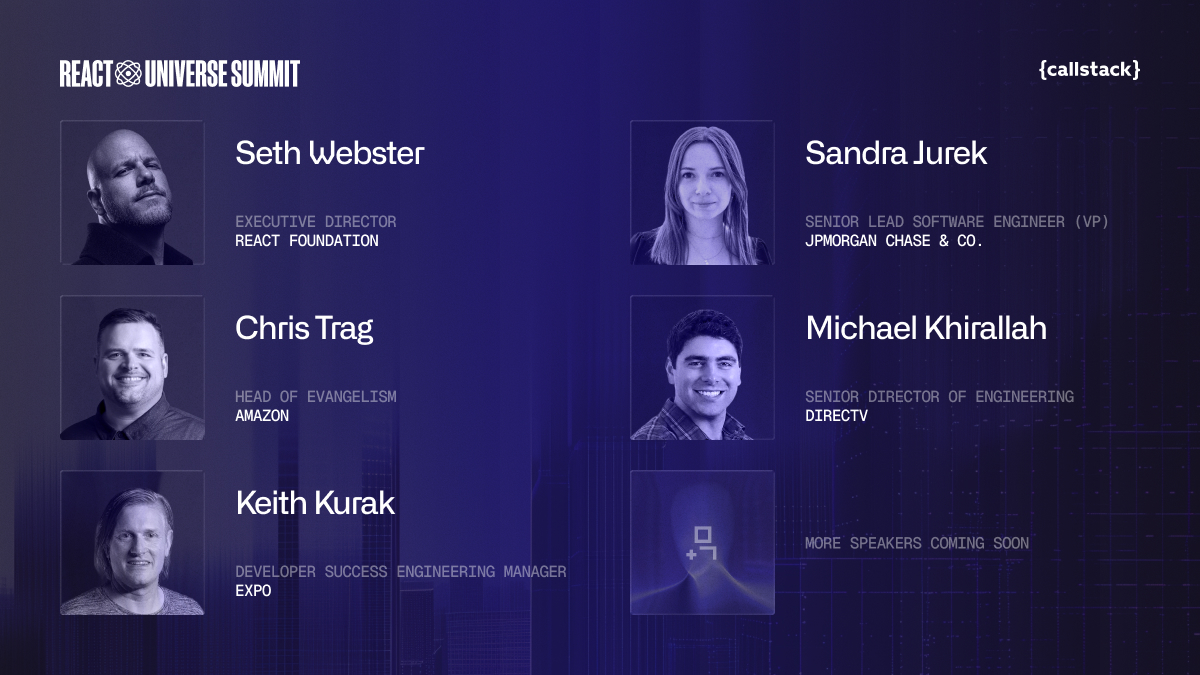
Together, they reflect the spectrum of decisions teams are making today, from architecture and platforms to developer experience and delivery at scale. Book your spot now to join the conversation or reach out to us to discover Partnership Opportunities.
KLJS x React Universe Meetup
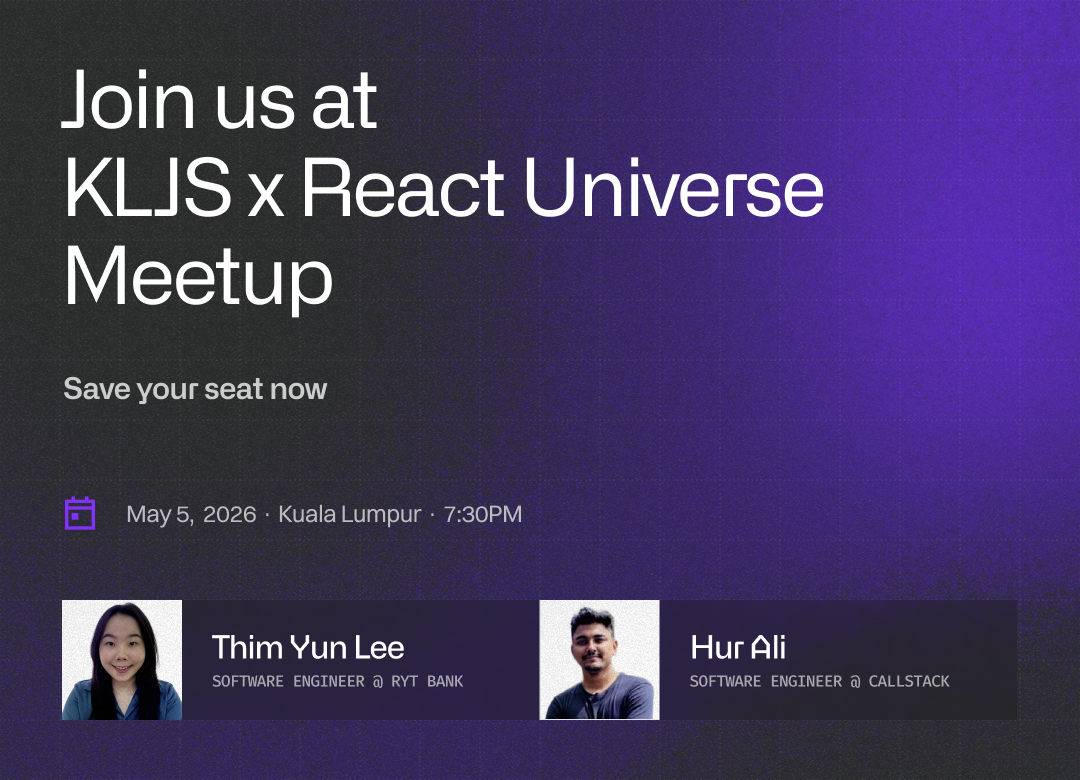
KLJS x React Universe Meetup is coming to Kuala Lumpur on May 5th at 7:30 PM, hosted at Ryt Bank.
This in-person session focuses on how React Native performs in real production environments. Expect practical insights from teams working on live systems.
Thim Yun Lee (Senior Engineer at Ryt Bank) will share what it takes to build and run a digital bank on React Native.
Hur Ali (Callstack) will walk through migrating native apps using AI-assisted workflows. Follow us for the third speaker announcement.
Join us for an evening of focused talks and open conversations with engineers working hands-on with React Native.
Agent Conf
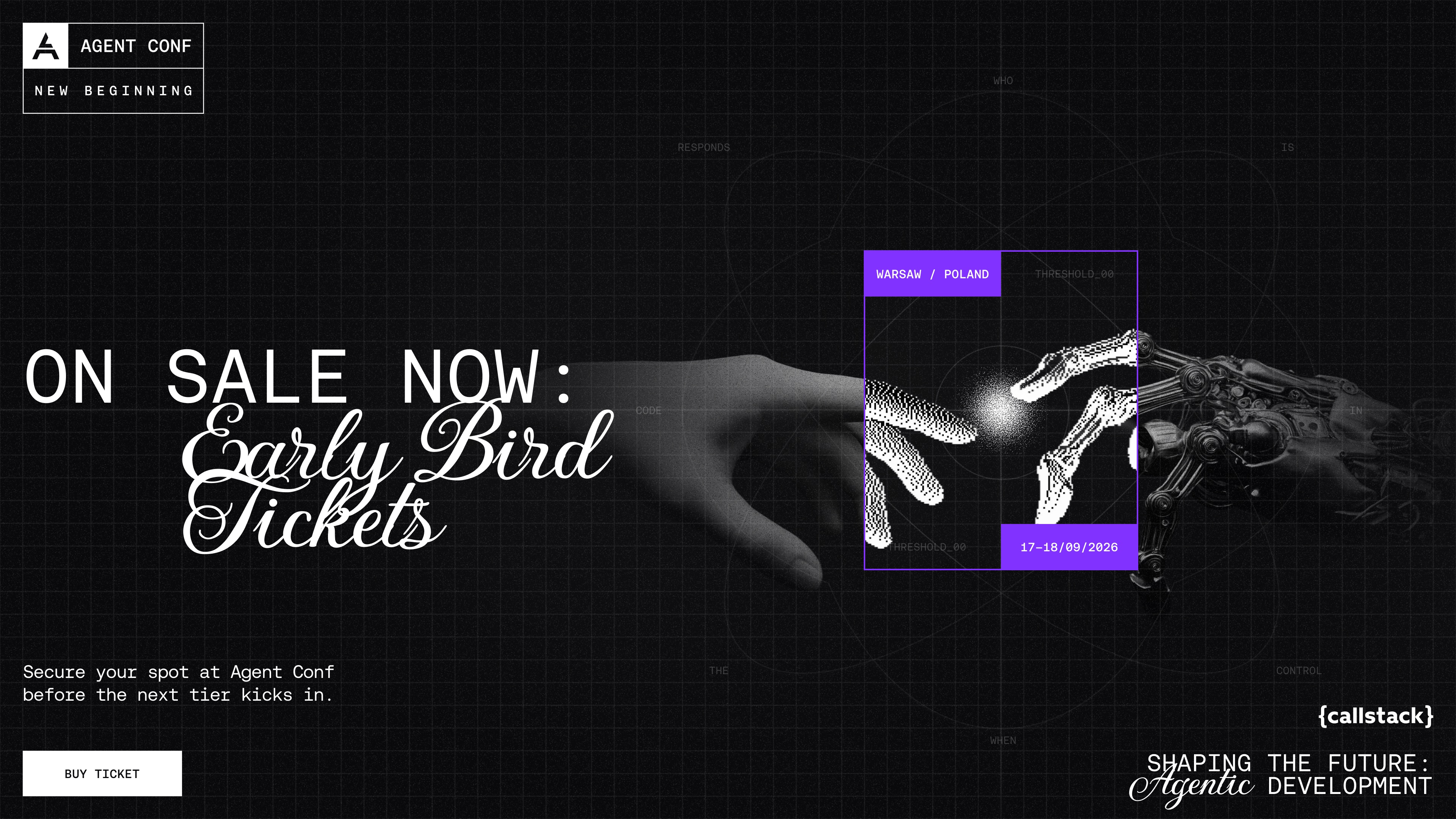
Our second big event takes place in Warsaw on September 17–18, 2026. It brings together engineers, founders, and product teams working with AI agents in real-world systems.
Since our last update, the first speakers have been confirmed. Here is who’s joining us in Warsaw:
Tejas Kumar who has spent over 20 years building for the web, from Spotify to Vercel to Xata, while helping teams understand how developers think, learn, and build.
Kent C. Dodds who is a full-time educator focused on helping developers build quality software, with years of experience across workshops, open source, and teaching core JavaScript and React concepts.
Kitze, who is known for building, shipping, and sharing the process openly, including what works, what doesn’t, and what’s worth trying.
Levan Kvirkvelia, who has spent years building products for real users, from scaling a product to 2 million users to co-founding Rork.
Nader Dabit who has worked across cloud, AI, web, blockchain, and mobile, with a focus on helping developers understand how to apply these technologies in practice.
David Mokos who is a YC alum who built SteerCode, the first mobile AI app builder on the App Store, later acquired by Expo. Now he works on agentic products within Expo.
Book your ticket here: https://www.agent.sh/
Your next read or watch starts here
Stay up to date with our latest insights on React, React Native, and cross-platform development from the people who build the technology and scale with it daily.