The Safe Detonation Chamber: Building AI You Can Actually Ship
The Safe Detonation Chamber: Building AI You Can Actually Ship
How to design production AI systems using Vercel AI SDK, Workflows, and Sandbox , covering vendor lock‑in, long‑running workflows, and secure code execution.
The Safe Detonation Chamber: Building AI You Can Actually Ship
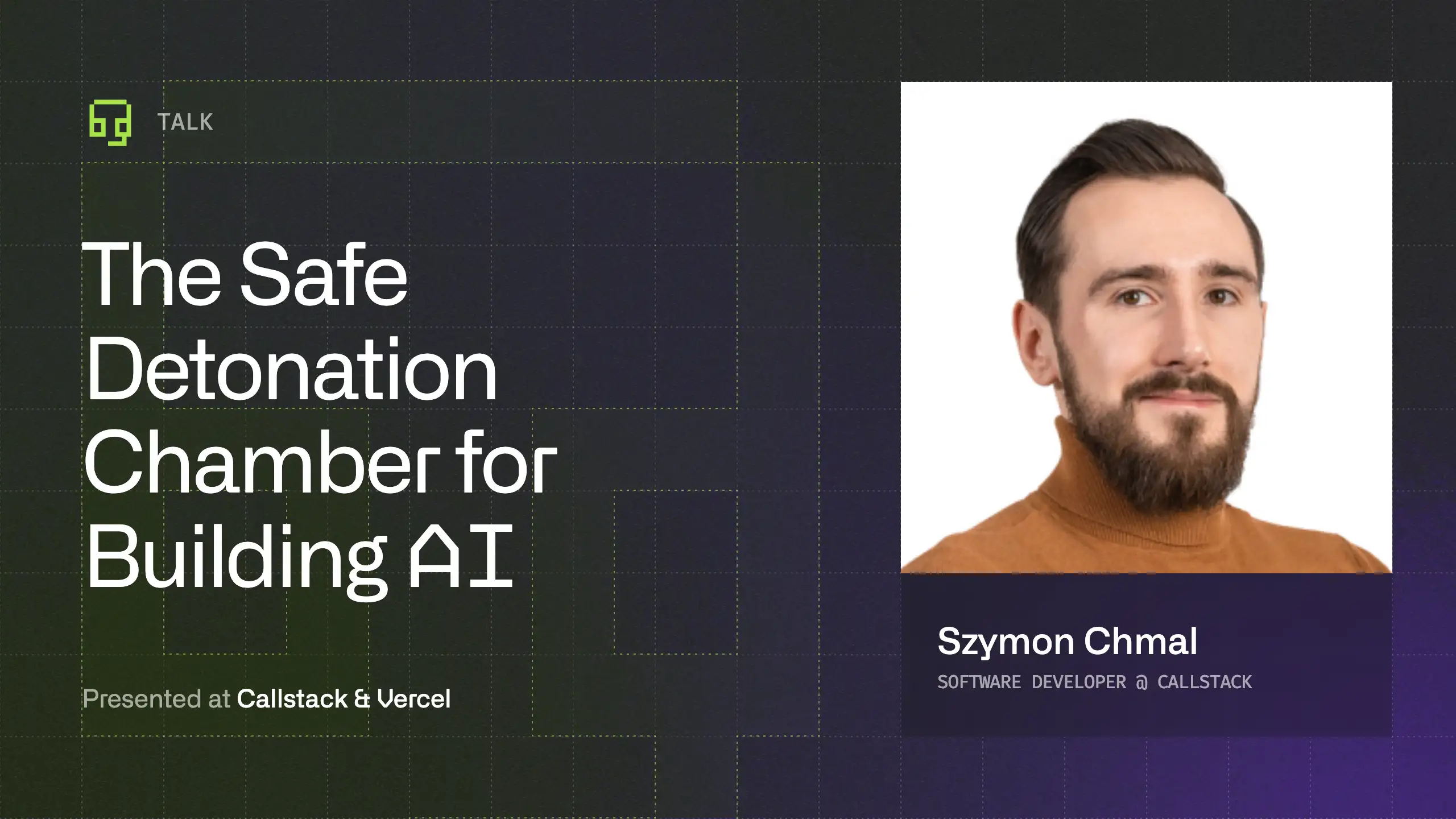


Szymon Chmal, Expert Software Engineer at Callstack and creator of tools like Rozenite, Harness, and Voltra, shared how teams can design AI systems that are safe to run in production. Using a practical example of an application that ingests files, extracts data with an LLM, generates code to process it, and produces reports, he showed how quickly simple AI demos turn into infrastructure problems. Once AI becomes part of a real product, teams need to deal with changing model providers, generated code execution, and workflows that can run far longer than a typical request–response cycle.
Instead of solving these issues with custom infrastructure, Szymon demonstrated how the Vercel stack addresses them directly. The Vercel AI SDK helps avoid vendor lock-in by allowing developers to switch models with minimal code changes while simplifying complex tool-calling loops. Vercel Workflows makes long-running AI tasks reliable through resumable steps, retries, and support for human-in-the-loop approvals. Finally, Vercel Sandbox provides a controlled environment for executing AI‑generated code, reducing the risk of prompt injection or malicious instructions affecting the main system.
What you’ll walk away with:
- Why vendor lock-in is a real risk when building AI-powered products
- How the Vercel AI SDK simplifies switching between model providers
- Why long-running AI tasks require durable workflows instead of standard serverless functions
- How human-in-the-loop approvals can improve reliability in AI systems
- Why generated code should always run in isolated sandbox environments
Watch the recording and see how to design AI systems that stay flexible, durable, and safe in production.
The Safe Detonation Chamber: Building AI You Can Actually Ship
How to design production AI systems using Vercel AI SDK, Workflows, and Sandbox , covering vendor lock‑in, long‑running workflows, and secure code execution.

Learn more about AI
Here's everything we published recently on this topic.




React Native Performance Optimization
Improve React Native apps speed and efficiency through targeted performance enhancements.
C++ Library Integration for React Native
Wrap existing C-compatible libraries for React Native with type-safe JavaScript APIs.
Shared Native Core for Cross-Platform Apps
Implement business logic once in C++ or Rust and run it across mobile, web, desktop, and TV.
Custom High-Performance Renderers
Build custom-rendered screens with WebGPU, Skia, or Filament for 60fps, 3D, and pixel-perfect UX.